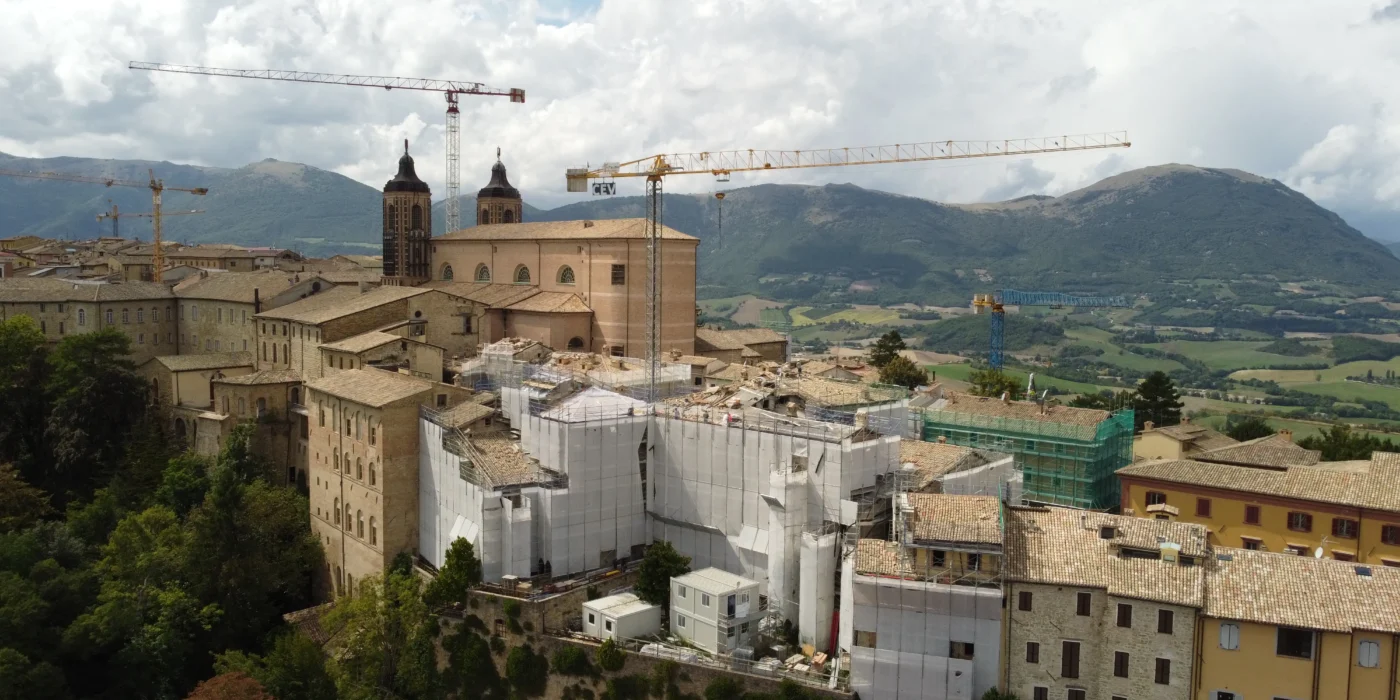
Interview on TG Regione for the construction of the new school canteen in Urbania
School building in Urbania: new prefabricated NZEB canteen funded by the PNRR
The school building project currently underway in the Municipality of Urbania (PU) was recently discussed in an interview given by Eng. Arch. Federico Paci to TG Regione, focusing on the construction of a new school canteen serving public buildings dedicated to primary and lower secondary education.
The project involves the construction of a new building near the “Della Rovere” school complex, within an area currently used partly as a public park and partly as a school courtyard. The intervention is funded under the PNRR – Next Generation EU, Mission 4 Education and Research, Component 1, Investment 1.2, and is developed at the Executive Design stage, with the aim of expanding and qualifying school services through the introduction of a canteen, a function that is currently absent.
A strategic facility for the local school system
The new canteen is conceived as a strategic infrastructure to strengthen the educational offer and support the extension of full-time schooling. The building is designed to serve primary and lower secondary schools in a coordinated manner, with dedicated pedestrian routes ensuring full integration with the existing school system. Promoted by the Municipality of Urbania, the intervention is part of a broader public program aimed at upgrading and modernizing the local school building stock.
Design approach, size, and functional layout
The building is developed on a single above-ground level within an area of nearly 2,000 square meters and is functionally organized into two main zones: the refectory and the service block.
The access system is differentiated: a main entrance dedicated to students arriving from the school courtyard, a secondary entrance that can also be used for extracurricular activities, and a service entrance reserved for staff and for loading and unloading goods. The internal layout includes a large refectory, a kitchen for meal preparation with separated clean and dirty flows, a pantry directly accessible from the outside, restrooms for users, staff changing rooms, and service spaces.
Prefabrication and seismic safety
From a structural standpoint, the project adopts a mixed construction system. The refectory is built using prefabricated reinforced concrete structures, while the service block is constructed with cast-in-place reinforced concrete, featuring a frame structure and a flat slab system in reinforced concrete and masonry.
Geotechnical investigations identified the need for deep pile foundations, ensuring the safety and stability of the building in relation to local soil conditions. The entire intervention is designed in compliance with current seismic safety regulations, providing high levels of protection for a facility intended for school use.
NZEB standards and building systems
The new school canteen is designed in accordance with NZEB (Nearly Zero Energy Building) criteria, through the integration of a high-performance building envelope and efficient building services systems. Energy demand reduction is achieved through passive strategies and high-performance construction solutions, while building systems are sized to maximize the use of renewable energy sources and minimize non-renewable primary energy consumption.
The building is equipped with direct expansion HVAC systems, ventilation systems to ensure proper indoor air exchange, a domestic hot water production system based on a heat pump, as well as complete electrical systems including standard and emergency lighting, grounding, and lightning protection.
Accessibility, fire safety, and maintenance
Thanks to its single-level layout and a design compliant with Ministerial Decree D.M. 236/1989, the building is fully accessible, ensuring usability for people with reduced mobility. From a fire safety standpoint, the canteen does not fall under activities subject to Fire Brigade control; nevertheless, the kitchen—powered partly by induction and partly by natural gas—is designed in full compliance with the applicable fire prevention regulations.
Construction and material choices prioritize durability, ease of maintenance, and long-term reliability, with particular attention to the use of dry construction systems and building services solutions that are easy to manage throughout the building’s lifecycle.
Executive design and integrated approach
The executive design is developed by ENGLOBE soc. cons. a r.l., coordinated by Eng. Arch. Federico Paci, with the contribution of a multidisciplinary team covering architecture, structures, building services, and geology. The intervention represents a concrete example of integrated design applied to school buildings, capable of translating regulatory requirements, sustainability objectives, and functional needs into a technically sound, efficient, and replicable solution.