Palazzo Parisani
Restoration and seismic improvement of Palazzo Parisani in Camerino
A Noble Palace in the Heart of Camerino
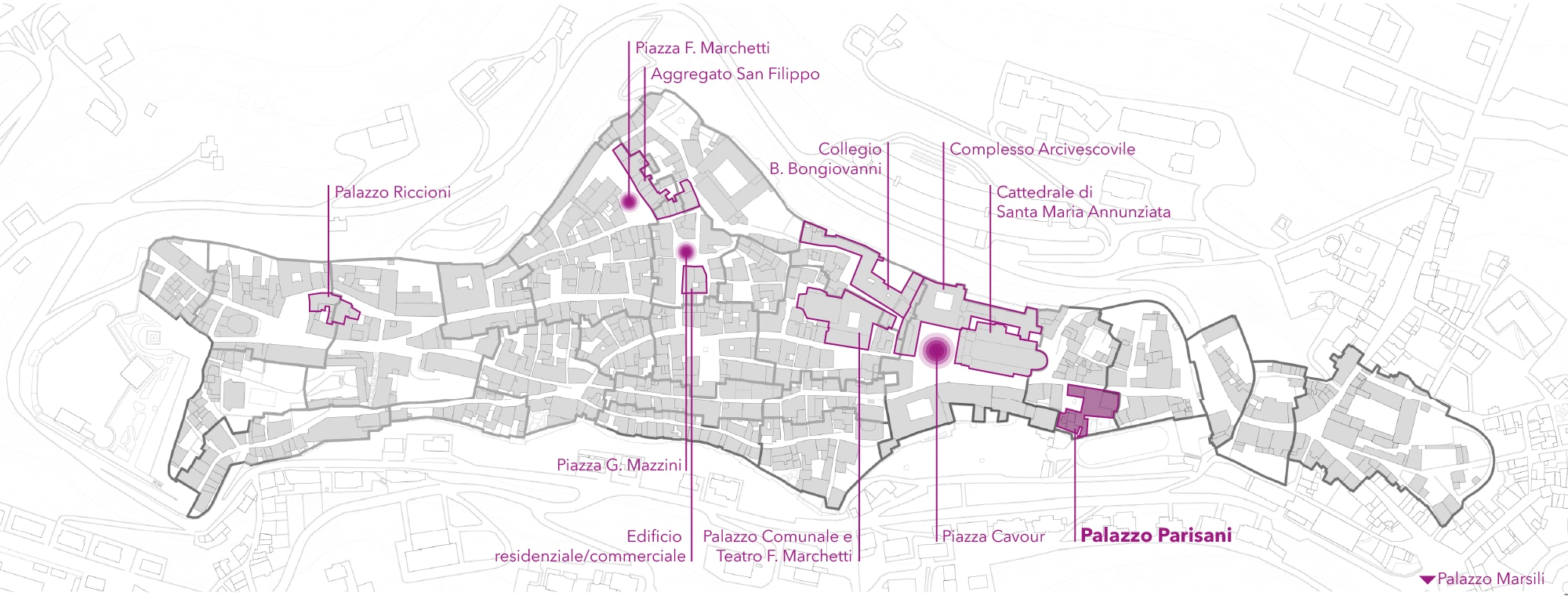
Palazzo Parisani stands between Via Roma and Largo della Pietà, in one of the most dense and layered urban settings of Camerino’s historic center. On one side it faces the city’s main street; on the other, it opens toward the ancient city walls and the historic landscape of Camerino, within the district once known as the Terziere di Sossanta.
It is a complex architectural organism, shaped over the centuries through additions, adaptations, and transformations: not an isolated building, but a readable fragment of Camerino’s urban history. The complex is divided into eight structural units arranged over seven levels, three of which are underground, reaching a maximum height of approximately fifteen meters above ground.
History: From the Strada and Zucconi Families to the Parisani Family
Palazzo Parisani is a seventeenth-century noble palace that belonged, over time, to the Strada, Zucconi, and Parisani families. Like many Italian historic buildings, it was created through the reuse of pre-existing structures, where each construction phase leaves a visible trace without completely erasing the previous one.
Next to the main body of the palace, the memory of the Casa di Varino Favorino can still be recognized. Favorino was a renowned humanist and philologist from Camerino who lived between the fifteenth and sixteenth centuries. The inscription on the lintel of a first-floor window, “AVR. PHA. ETTOS. NUCERINO,” turns an architectural detail into a historical document, testifying to Favorino’s acquisition of the building in the early sixteenth century. It is one of the elements that make Palazzo Parisani not only a building to be restored, but also a concrete testimony to Camerino’s cultural identity.
The 2016 Earthquake: Cracks, Vulnerabilities, and the Need for Intervention
The 2016 seismic events disrupted the structural balance of the building. The entire property was classified with an E-level usability rating, the highest level of post-earthquake unusability, with municipal ordinances issued between June 2017 and February 2018.
Cracks, structural damage, and vulnerabilities affected both the load-bearing structure and the decorative features, making a unified design approach necessary. The crack pattern revealed, in particular, the risk of façade overturning, already partially activated at the side walls, as well as shear damage in the masonry walls most exposed to in-plane seismic action. The complex had already undergone post-earthquake works after the 1997 earthquake, including grout injections in the masonry, replacement of deteriorated beams, and partial roof reconstruction.
The Intervention: Architectural Restoration and Structural Safety
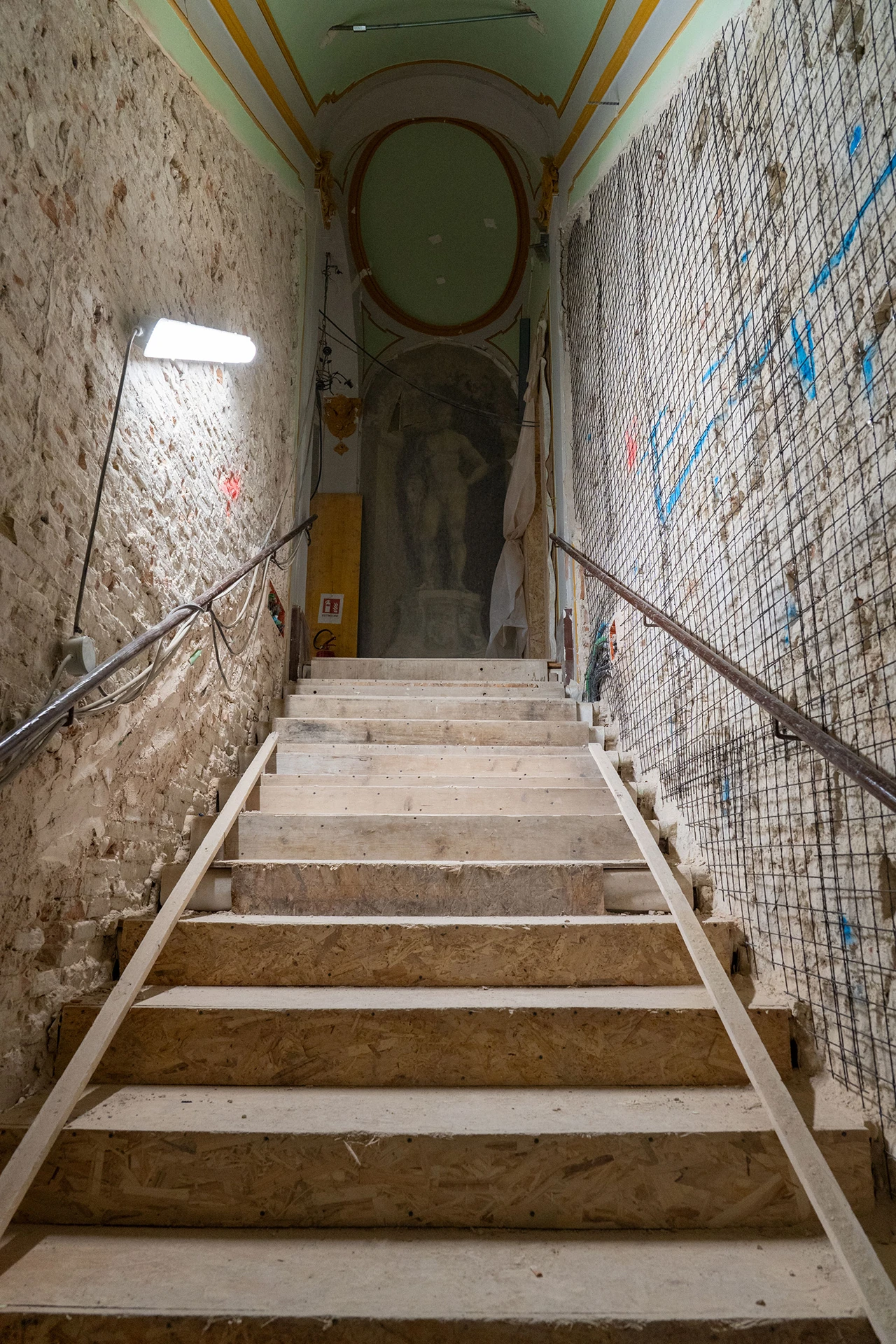
The restoration and seismic improvement project for Palazzo Parisani was developed across several coordinated fronts. The consolidation of the stone masonry walls involved masonry stitching, repointing of mortar joints, injections of natural hydraulic lime-based binders, and the application of fiber-reinforced meshes with lime-based finishing plaster. The façades, severely damaged by the earthquake, also benefited from the Fibrenet Reticola system in the exposed masonry area overlooking Largo della Pietà.
The recovery and strengthening of the timber floors included dismantling, cataloging, and selective replacement of deteriorated beams, together with metal edge reinforcement and bracing plates. The structural masonry vaults were emptied, stiffened with galvanized steel-fiber strips, and connected to the masonry walls through steel angles. Roof restoration involved dismantling the entire clay tile covering, applying anti-woodworm treatment to the existing timber trusses, replacing unrecoverable elements with new chestnut timber, and installing a metal truss ring beam to connect the roof structure to the load-bearing masonry. Steel tie rods, inserted in both directions with visible anchor plates, complete the anti-overturning system for the perimeter walls.
The objective was to restore structural safety without altering the architectural identity of the palace, working on the existing fabric through a strategy of active conservation.
The Decorative Features: The Building’s Fragile Memory
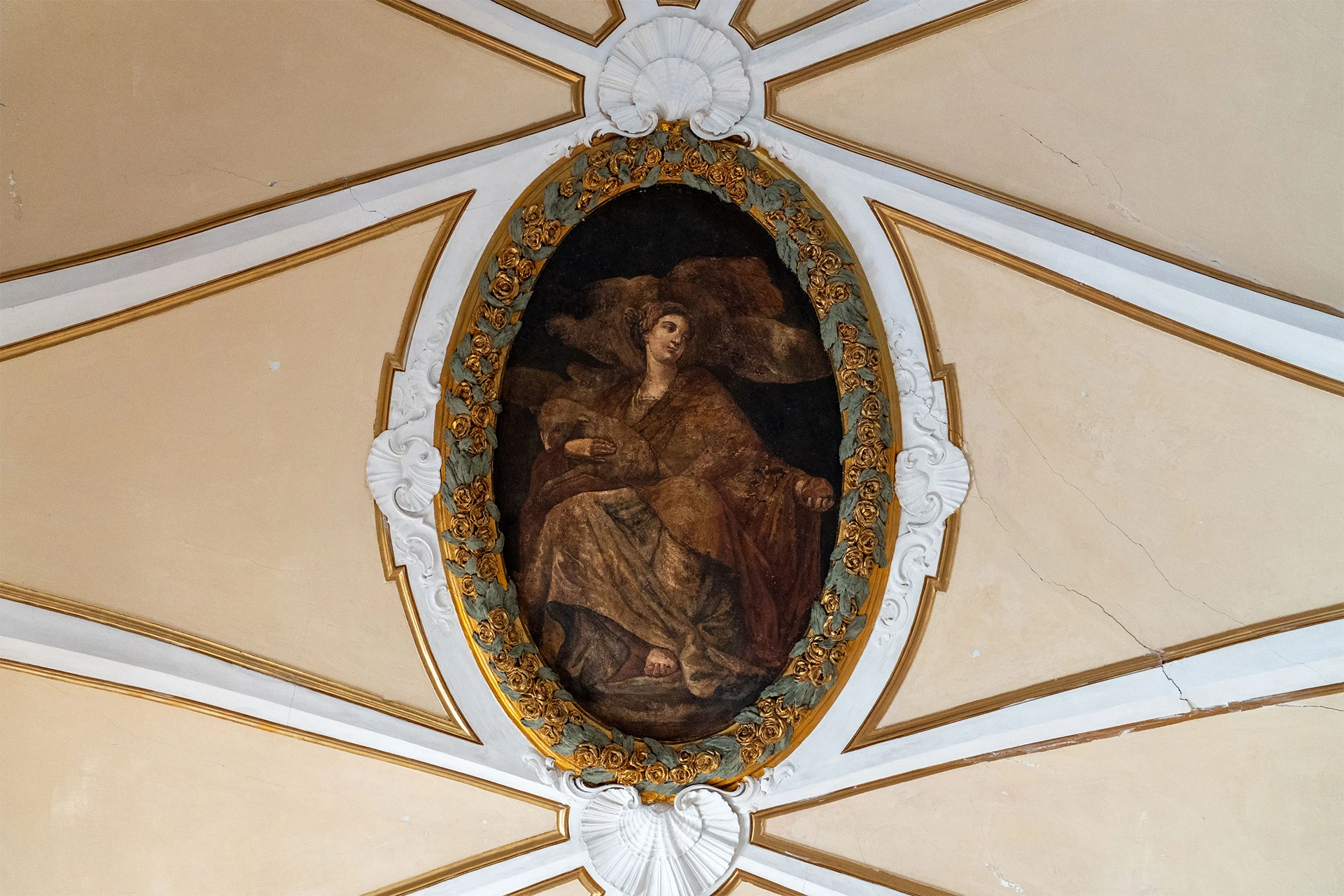
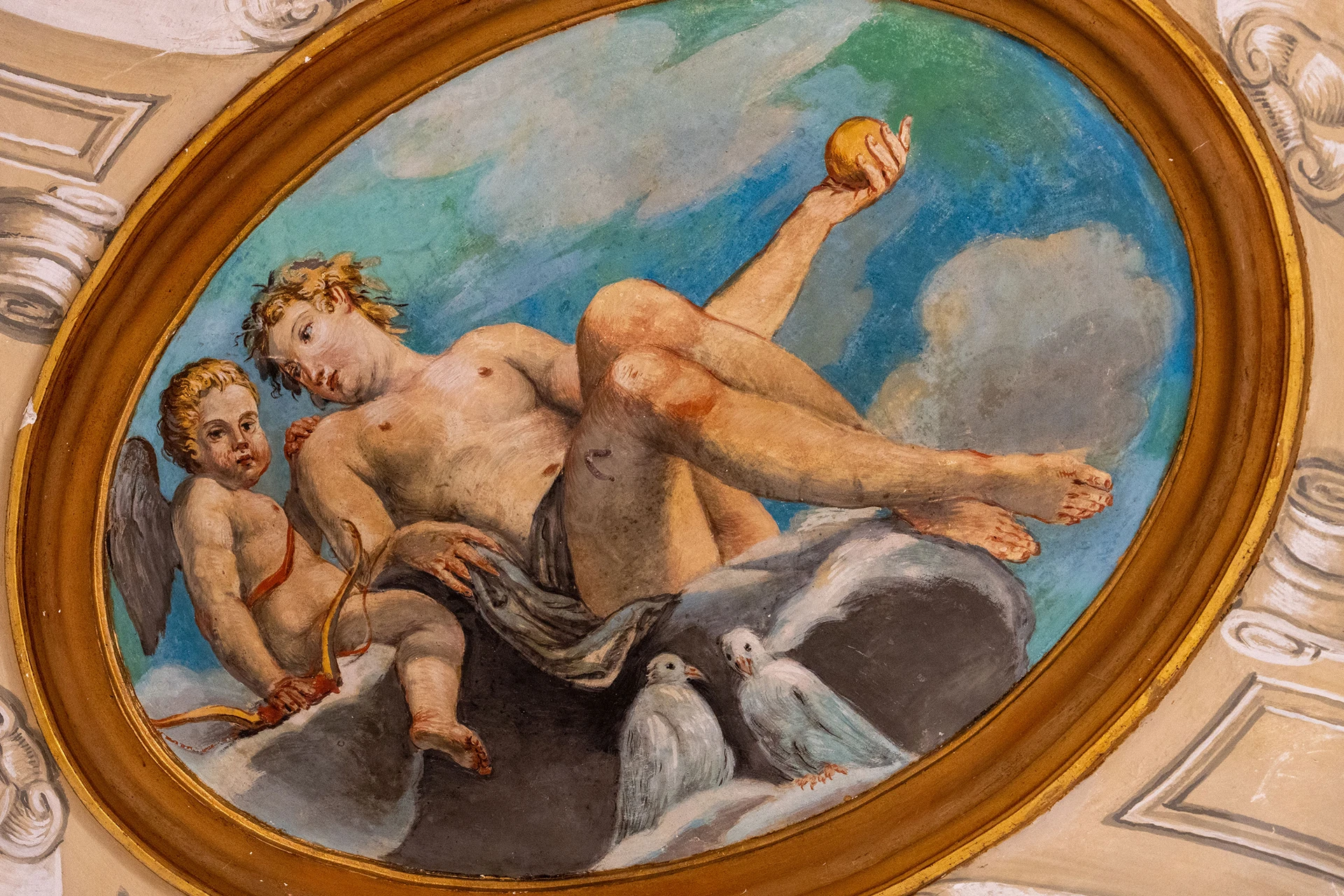
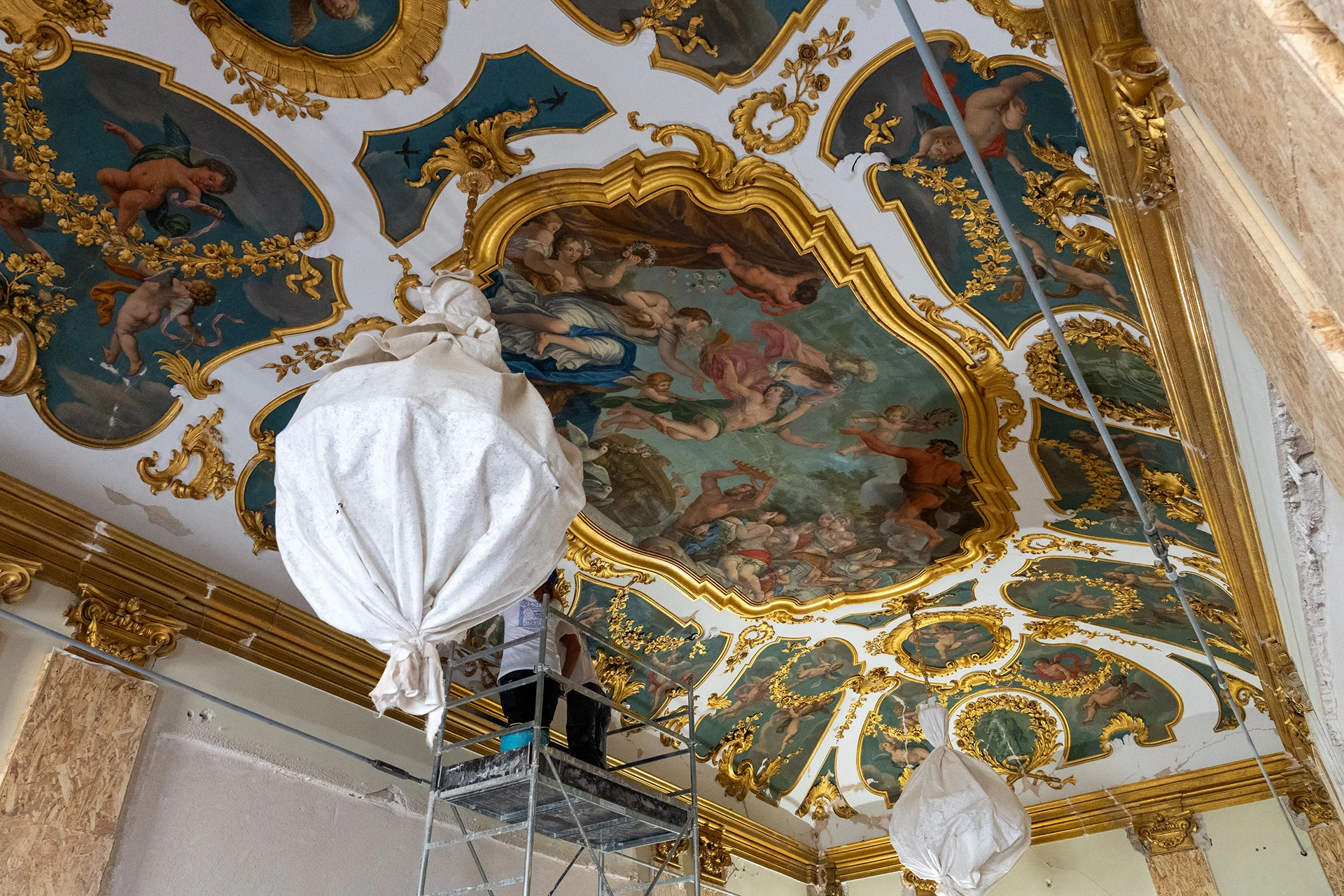
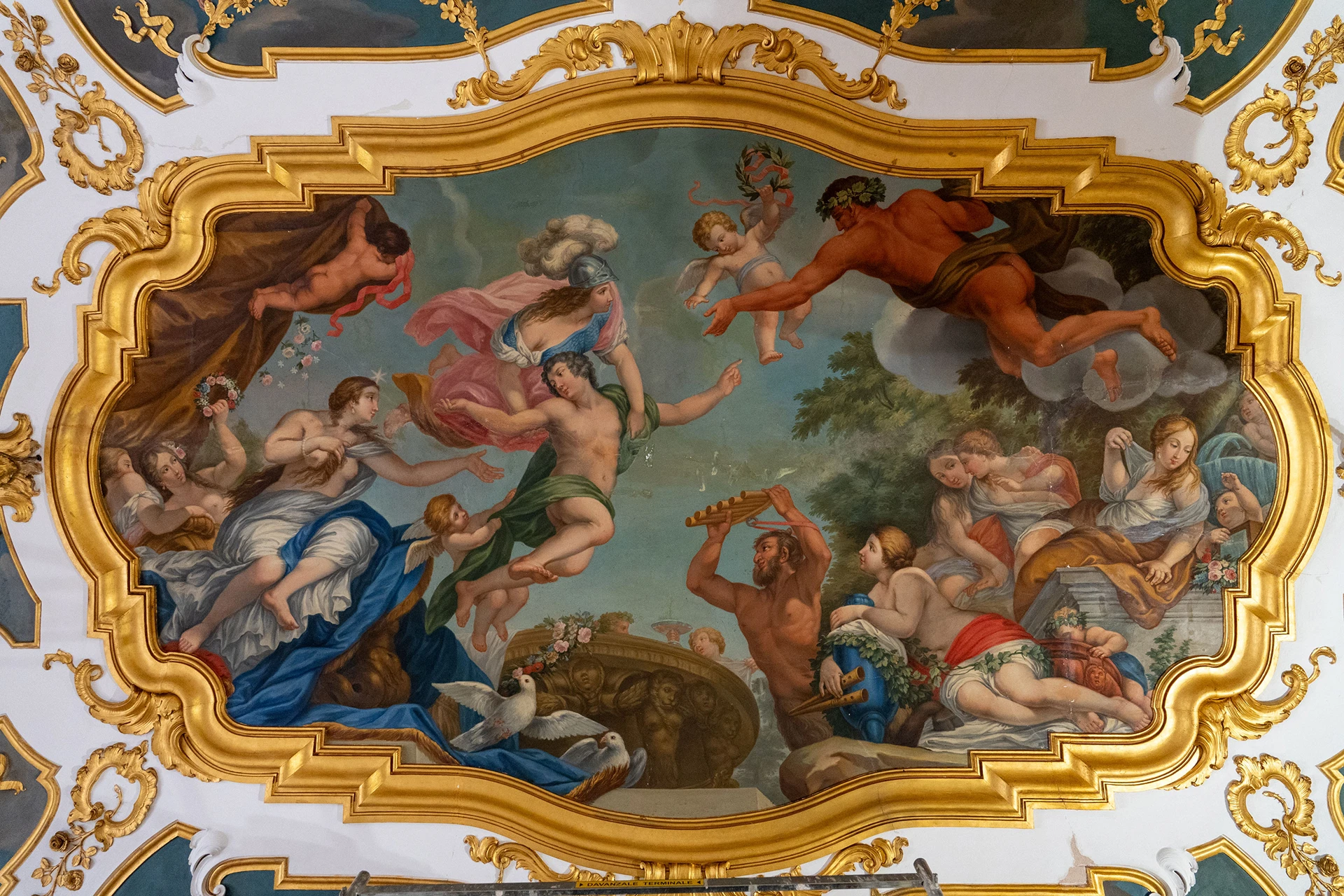
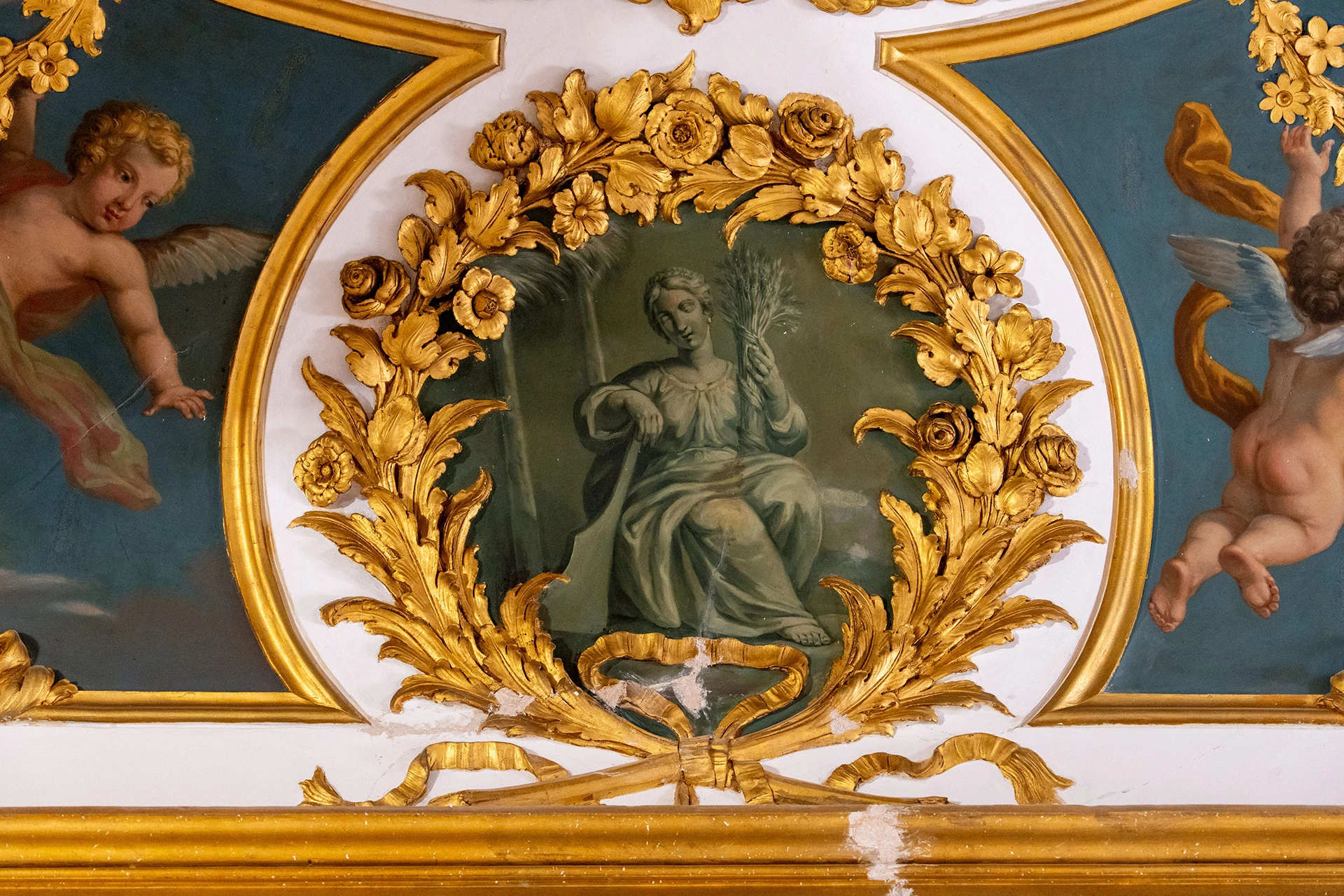
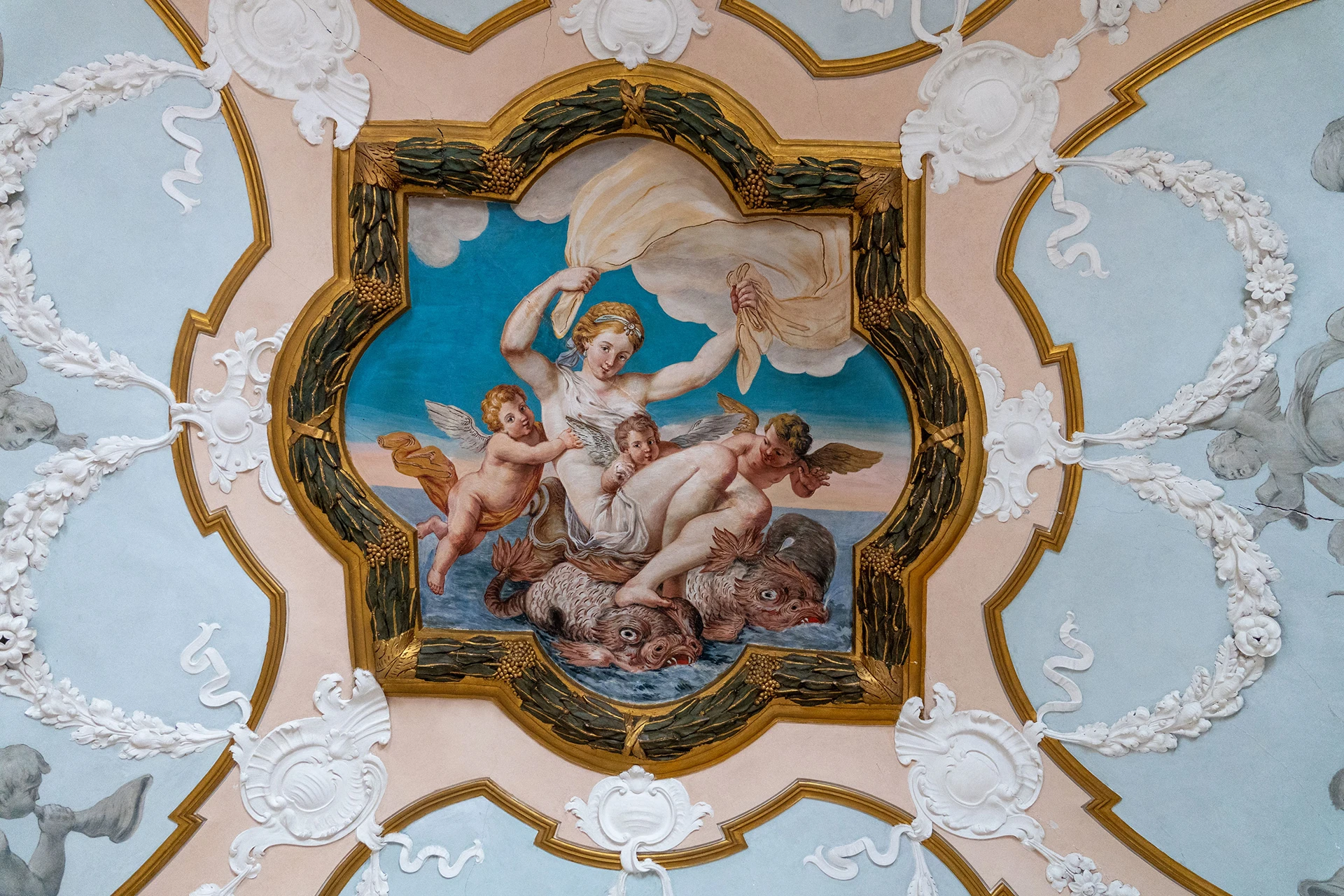
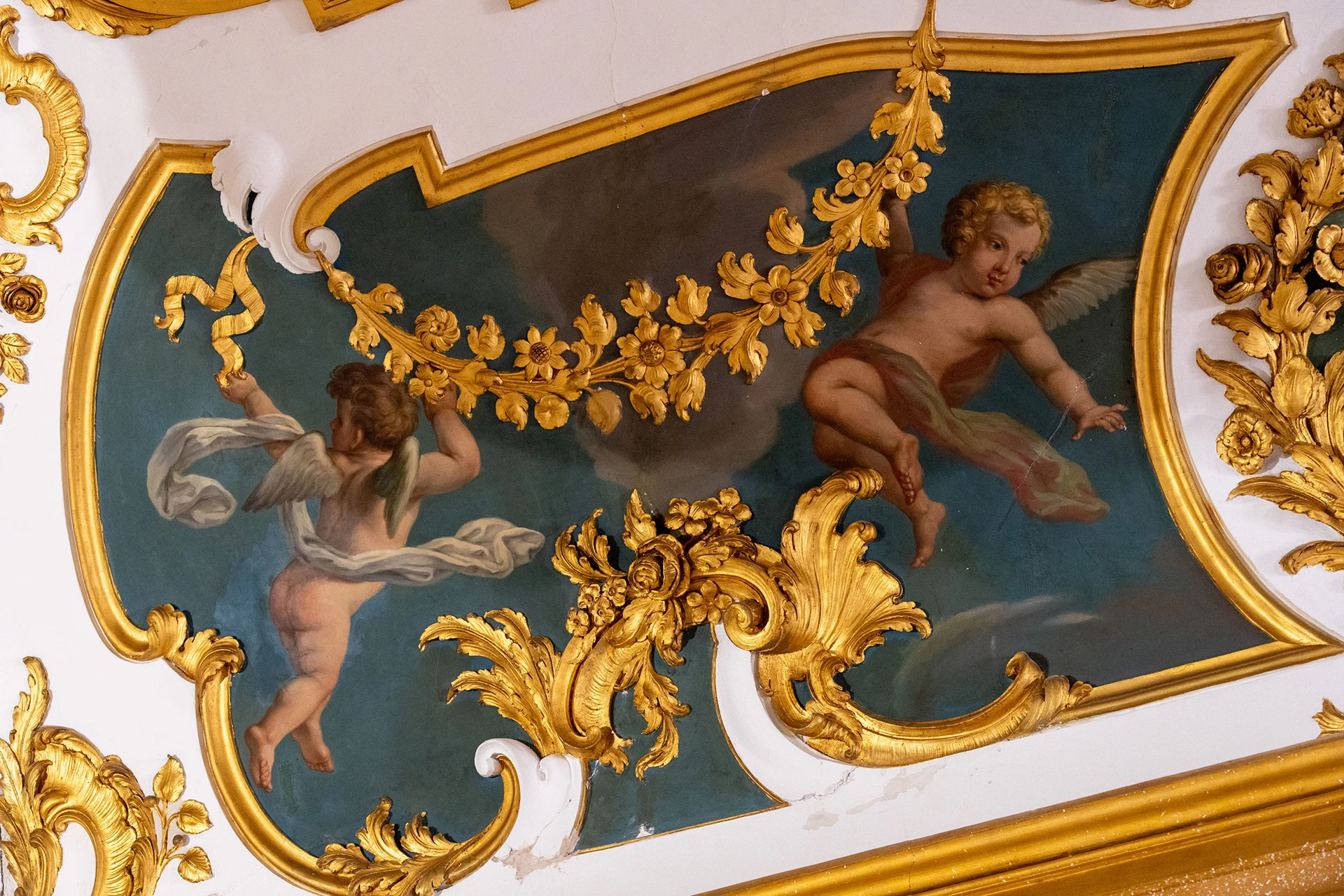
One of the most delicate aspects of the intervention concerns the interior decorative features. Vaults decorated with tempera paintings on plaster depicting mythological subjects, stuccoes with molded floral and geometric elements, sandstone portals with rustication and mascarons, solid wood doors of notable Baroque value, gilded cornices, and terracotta flooring: after the earthquake, each of these surfaces represented an active front of deterioration.
The earthquake caused cracks, detachments, losses, and localized failures, especially around the corner supports of the camorcanna vaults, a construction system made of interwoven reed mats, typical of noble interiors in Central Italy. The project required continuous coordination between qualified restorers and structural designers, beginning with a first stabilization phase before any construction work could take place: protective bandaging, localized micro-injections of natural hydraulic lime, and stratigraphic tests to identify valuable surfaces concealed beneath more recent layers. Only in a second phase, after structural consolidation had been completed, was it possible to proceed with the final restoration, including pictorial reintegration, filling of losses, and surface protection with low-concentration acrylic resins.
This step expresses one of the fundamental principles of the ENGLOBE method: the safety of the building and the conservation of its beauty are not separate objectives, but parts of the same project.
Palazzo Parisani within the Post-Earthquake Reconstruction of Camerino
The restoration is part of the broader post-earthquake reconstruction process affecting the historic center of Camerino. Each recovered building does not simply restore usable spaces: it reactivates a piece of the city, a sequence of façades, and a collective memory.
In the case of Palazzo Parisani, the value of the intervention lies in its ability to combine technical precision with architectural storytelling. Masonry consolidation, roof recovery, protection of decorative features, and historical interpretation of the building aggregate become tools for bringing life back to a building made fragile by the earthquake. Palazzo Parisani returns not only as a restored heritage asset, but as a concrete example of how reconstruction can become knowledge, care, and the recovery of architectural identity.
Chi era Varino Favorino e perché il suo nome è inciso su una finestra di Via Roma?
Varino Favorino fu un umanista camerinese formatosi a Firenze sotto la guida di Poliziano e poi precettore dei figli di Lorenzo il Magnifico, tra i quali il futuro papa Leone X. Nel primo Cinquecento acquistò la casa oggi inglobata nel complesso di Palazzo Parisani, e l'iscrizione "AVR. PHA. ETTOS. NUCERINO" sull'architrave di una finestra del primo piano ne attesta ancora la presenza, un testo antico nella pietra che ogni restauratore ha dovuto proteggere con la stessa cura riservata alle volte dipinte.
Cosa lega la famiglia Parisani a Napoleone Bonaparte?
Il pittore Napoleone Parisani, ultimo discendente illustre della famiglia, nacque a Camerino nel 1854 da madre principessa Emilia Gabrielli di Prossedi, la cui nonna era Charlotte Bonaparte Gabrielli, figlia primogenita di Lucien Bonaparte, fratello di Napoleone. Il sangue imperiale scorreva nelle vene di chi dava il nome al palazzo, e per opposizione della madre, lo stesso pittore non poté mai condurvi la sua compagna di vita Adelaide Lucaferri. Un palazzo con radici bonapartiste che oggi, grazie al restauro post-sisma, torna a raccontare questa storia.
PLACE
Camerino (MC)
CLIENT
Private
WORK PERIOD
2022 / 2024
ACTIVITY
Construction Design
CSP
Detailed Design
PROJECT TYPE
Conservative Rehabilitation
Restoration of Listed Cultural Heritage
INTENDED USE
Residential
WORK AMOUNT
€ 8.000.000,00
WORKING GROUP
Englobe
Geol. Marco Caporaletti
Ing. Carlo Morosi