Italian Restoration and Aseer Historic Villages: a Methodological Dialogue Between Italy and Saudi Arabia
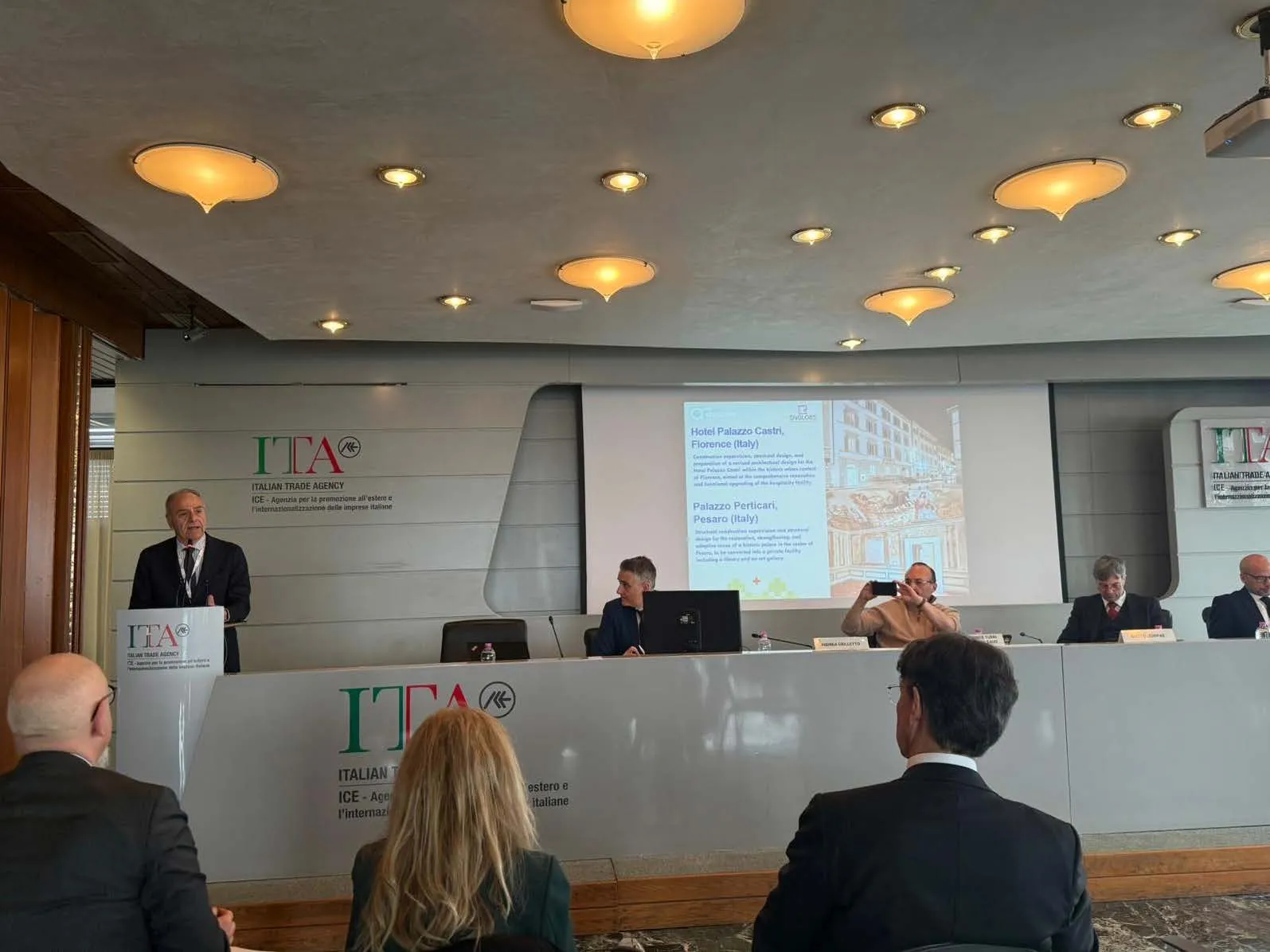
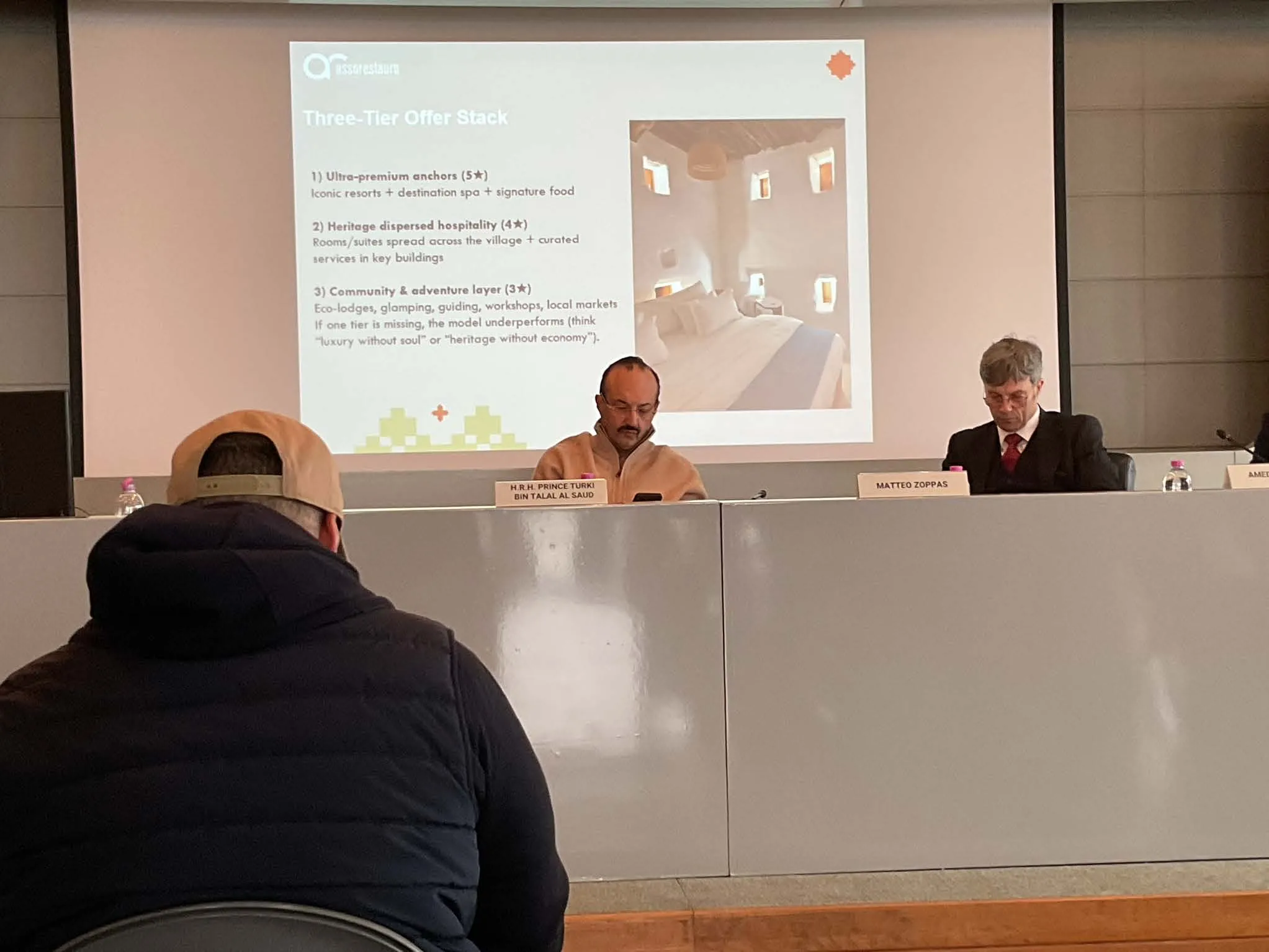
The Italy–Aseer Strategic Cooperation workshop, promoted by Assorestauro at the Rome headquarters of ITA – Italian Trade Agency, offered an opportunity for technical and institutional dialogue between Italy and Saudi Arabia on the conservation of built heritage, adaptive reuse, and the regeneration of historic villages. The meeting brought together institutions, companies, and professionals from the Italian restoration supply chain, in a dialogue aimed not so much at defining individual design solutions, but at building a shared methodology.
At the center of the discussion was the Aseer Region, a territory in Saudi Arabia characterized by historic settlements, traditional architecture, and significant cultural landscapes, now at the core of sustainable tourism development strategies. The issue raised by the Saudi context does not concern a single building, but a territorial scale: general planning, master planning, preservation of local construction identity, economic sustainability of interventions, and long-term management.
This challenge requires a rigorous operational sequence — knowledge-based survey, material and structural diagnosis, vulnerability assessment, compatible-use design, interference management, and life-cycle control of the intervention — rather than pre-packaged solutions.
Four Case Studies to Understand the Complexity of Contemporary Restoration
During the meeting, engineer Marco Montagna presented a selection of projects designed to illustrate how the Italian technical culture of restoration addresses highly diverse operational contexts today: from hospitality reuse within historic urban fabric to the enhancement of archaeological parks, up to structural design in international scenarios.
Hotel Palazzo Castri, Florence
Construction supervision, structural design, and architectural design revision for the upgrading of a hospitality facility located within Florence’s historic urban fabric.
Palazzo Perticari, Pesaro
Structural design and structural construction supervision for the restoration, strengthening, and reuse of a historic building now intended for private functions, a library, and an art gallery — a case study that highlights the tension, typical of contemporary restoration, between conservation and new uses.
Villa Massenzio, Rome
Design, construction supervision, and safety coordination for the conservation restoration of the archaeological site along the Appian Way and the creation of new visitor routes, with the objective of making a particularly fragile heritage asset accessible without compromising its integrity.
Diamond Star of the East Resort, Zanzibar
Structural design for the expansion of an international residential and hospitality complex, including new suites and supporting infrastructure — a project that demonstrates the ability to transfer Italian structural expertise to construction and regulatory contexts different from those of Europe.
Taken together, these four interventions outline a cross-disciplinary competence that spans the Italian heritage protection framework — starting from Legislative Decree 42/2004 on cultural heritage — the management of complex hospitality operations, and structural design in international contexts characterized by heterogeneous regulations, materials, and climatic conditions.
From Individual Case Studies to Method: Applying Italian Expertise to Aseer
The most relevant aspect of the dialogue lies not so much in the individual projects presented, but in the attempt to extract from them a transferable method. In historic contexts, recovery cannot be reduced to a façade operation: it requires data, diagnostics, and verifiable design decisions capable of bringing together requirements that are often in tension with one another.
Applying Italian experience to the Aseer case means building a decision-making matrix capable of connecting heterogeneous variables:
- material authenticity and local construction techniques;
- functional compatibility between new uses and existing structures;
- reduction of intervention invasiveness;
- seismic and structural control;
- accessibility and tourism-oriented use;
- non-invasive building systems management;
- planned maintenance over time.
This approach avoids two opposite risks: purely museum-like conservation, which isolates heritage from contemporary life, and indiscriminate transformation, which erases its identifying features. From this perspective, the Italian model works less as a catalogue of exportable solutions and more as a working methodology, based on preliminary knowledge, gradual intervention, and adaptation to the material and cultural conditions of the Saudi context — climatically, constructively, and normatively different from the European one.
Adaptive Reuse as the Central Issue
The theme of adaptive reuse, recurring across all the case studies presented, is confirmed as the most useful interpretive key for understanding the direction of the Italy–Aseer dialogue. It is an approach that allows historic buildings and settlements to regain function and life — through tourism, culture, and hospitality — without erasing their construction identity, original materials, and documentary value, which make them historical evidence before anything else.
Future developments in the cooperation between Italy and the Aseer Region will need to verify the extent to which this methodological framework can be translated into concrete interventions on a heritage system characterized by specific construction and climatic features, which cannot be reduced to a linear transfer of solutions originally designed for the Italian context.
What was ENGLOBE’s role in the Italy–Aseer Strategic Cooperation meeting?
ENGLOBE participated through Marco Montagna’s presentation, bringing Italian and international case studies related to restoration, structural strengthening, construction supervision, archaeological enhancement, and adaptive reuse.
What is the Italy–Aseer Strategic Cooperation workshop?
It is a technical and institutional meeting promoted by Assorestauro at ITA – Italian Trade Agency in Rome, dedicated to cooperation between Italy and Saudi Arabia on heritage conservation and the regeneration of the historic villages of the Aseer Region.